Treat
A decentralised treatment barrier at the point of use.

Solutions
Our sites
Solutions · Filter
Water quality often plays out where the network ends: at the user. Drop! brings decentralised filtration there: a final barrier, doubled with quality vigilance, closest to the tap.

At the last metre
Water secured
The weak link
Water is treated at scale, then travels kilometres of network before reaching the user. Along the way, several factors degrade quality at the point of consumption: exactly where it matters most.
Residence time
At the network’s edge, water stagnates: residual chlorine decays, protection weakens.
Old connections
The last metres (private pipes, old materials) escape central treatment.
Taste & trust
Taste, odour, occasional turbidity: the user’s perception forms at the tap, not at the plant.
Hazards & resource
Network incident, drought, resource mixing: resilience is built closest to use.
The Drop! approach
Rather than over-treating the whole network, Drop! places a decentralised barrier where water is drunk. The tap module combines a final treatment and the platform’s quality vigilance: securing and monitoring in the same place, at the last metre.
A decentralised treatment barrier at the point of use.
Embedded quality vigilance watches the water signature continuously.
On deviation, the user and operator are informed, closest to the field.
Swipe to see the full circuit
Every metre travelled wears down protection: the Robinet module restores it at the point of use.
Centralised & decentralised
Decentralised filtration does not replace central treatment: it complements it, where it reaches its limits.
Centralised treatment
Where
At the production plant
Coverage
The whole network, upstream
After treatment
Kilometres of network to travel
Monitoring
Upstream self-monitoring
Resilience
Depends on the network
Drop! decentralised filtration
Where
At the point of use, at the user
Coverage
The last metre, targeted
After treatment
No travel: water is drunk here
Monitoring
Embedded quality vigilance, continuous
Resilience
Local, autonomous barrier
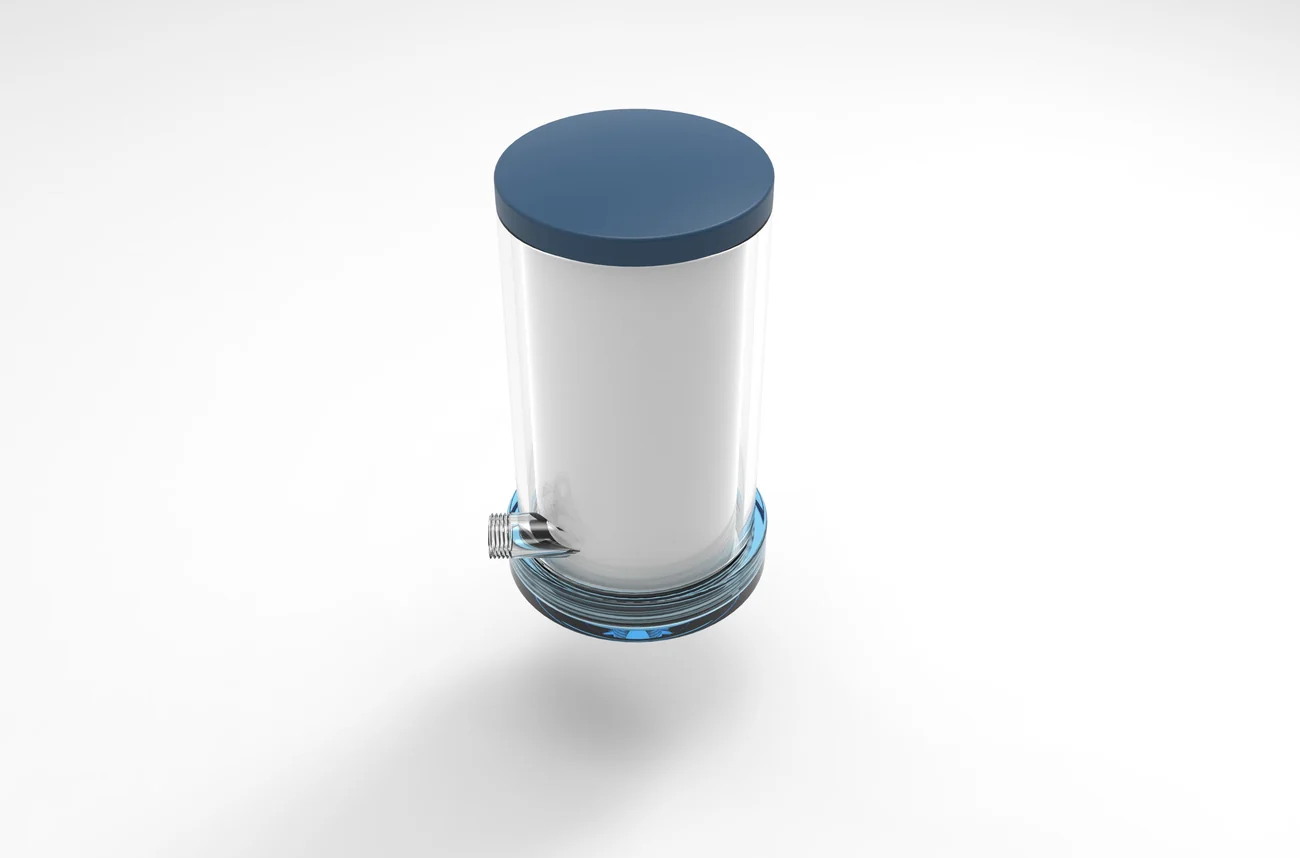
The tap module
The format closest to use. The tap module combines an activated-carbon filtration with the vigilance sensor in a discreet housing. The bulk media is rechargeable, with no disposable cartridge, and it is the sensor that drives the recharge: it measures the real state of the filtration and signals the precise moment, instead of a blind replacement.
At the point of use
Installed at the tap, closest to consumption.
Sensor-driven carbon
Rechargeable bulk media, no disposable cartridge; the sensor tells you when to recharge.
Autonomous
Runs on a long-life battery: no wiring, no mains dependency.
Replaceable in seconds
The user changes the media themselves, with no tool or technician.
Where it matters

Utility
Long residence time, low renewal: the final barrier secures drinking water despite the distance.
Public venue
Vigilance and treatment at the point of consumption, for sensitive audiences.
Housing
Protection of the last metres, where private pipes escape central treatment.

Resilience
Extra security in case of a hazard on the network or the resource.
What it changes
Health safety
A final barrier and continuous vigilance, at the point of consumption.
Micropollutants & PFAS
At the point of use, activated carbon targets micropollutants: notably long-chain PFAS and certain highly hydrophilic pesticide metabolites (laboratory tests, under qualification).
Sobriety
Secure drinking water where it matters, without over-treating the whole network.
Trust & transparency
The user sees, understands and is alerted: the bond with water is restored.
Go further
Let’s study a decentralised filtration deployment on your sensitive points of use.